If you’ve asked a few contractors this question, you’ve probably gotten a few different answers. That’s because thickness isn’t a one-size-fits-all number, it depends on what’s driving over that slab, what’s underneath it, and how well it’s built to handle Alberta’s freeze-thaw cycles. Get it wrong and you’ll be looking at cracking, heaving, or a driveway that just doesn’t hold up the way it should.
Calgary homeowners often assume a thicker slab automatically means a stronger driveway, but that’s only half the story. A well-built 4-inch driveway on a properly compacted base will outlast a poorly prepped 6-inch slab almost every time. Thickness matters, but it works together with the base, the reinforcement, and the mix design, not on its own.
This article breaks down the actual thickness standards for residential driveways in Calgary and Airdrie, when you need to go thicker, and why the base underneath matters just as much as the number of inches of concrete on top.
Standard Thickness for a Residential Driveway
For a typical residential driveway handling passenger vehicles, the industry standard in Calgary is 4 inches of concrete. This is the baseline most homeowners need for a standard car, SUV, or minivan driveway.
On most Calgary jobsites, we see 4 inches as the sweet spot for standard use because it balances cost, durability, and structural performance for typical residential loads. Going thinner than that isn’t recommended, even for light vehicle traffic, because it doesn’t leave enough margin for Alberta’s ground movement.
What 4 Inches Handles Well
- Daily parking for cars, SUVs, and minivans
- Occasional guest vehicles and light foot traffic
- Standard driveway width and length for a single or double garage
If your project is a straightforward driveway replacement for typical vehicle use, 4 inches paired with a properly compacted base is usually all you need. You can see typical specs and finishes on our concrete driveways page.
When You Need to Go Thicker
Not every driveway sees the same kind of traffic. Heavier vehicles put more downward stress on the slab, and that stress needs to be distributed properly or you’ll start seeing cracking at stress points within a few years.
Heavier Trucks and Commercial Vehicles
If your household regularly parks a heavier pickup, a work truck, or a trailer, 5 inches is usually the better call. Experienced concrete finishers know that the extra inch makes a real difference in how the slab handles concentrated point loads, especially where tires repeatedly sit in the same spot.
RV Parking and Extended Load Areas
RVs and larger trailers are a different situation altogether. These vehicles are heavy, often sit in one place for extended periods, and put sustained load on a smaller footprint than a moving car. For RV parking pads or driveway sections designed to hold an RV, 6 inches is the standard we recommend, sometimes more depending on the size and weight of the unit.
Garage Pads and Shop Floors
If you’re pouring a garage pad meant to handle heavier equipment, tools, or a vehicle lift down the road, thickness requirements shift again. This is worth discussing directly with your contractor since garage pad specs vary more than standard driveway specs.
Reinforcement Matters as Much as Thickness
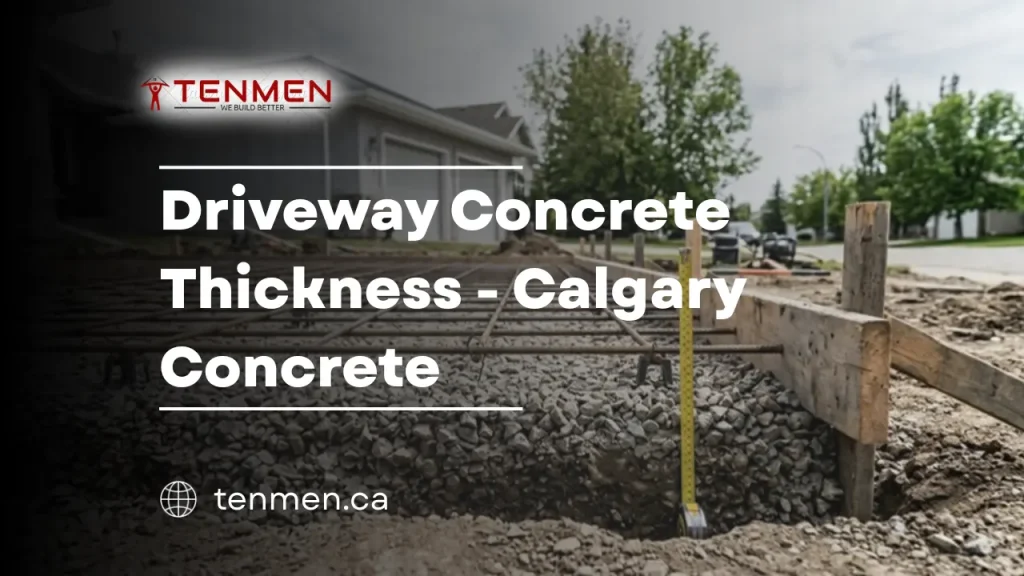
A slab poured without reinforcement is more vulnerable to cracking, no matter how thick it is. Reinforcement helps hold the concrete together if cracking does occur, which keeps small cracks from turning into major structural failures.
Common Reinforcement Methods
- Rebar grids: Steel rebar laid in a grid pattern before the pour, standard for residential driveways handling normal to heavier loads
- Wire mesh: A lighter reinforcement option sometimes used for lighter-duty applications, though rebar is generally the stronger choice for Calgary’s climate
- Fibre-reinforced concrete: Synthetic fibres mixed directly into the concrete to help control shrinkage cracking
One of the most common mistakes homeowners make is assuming a thicker pour eliminates the need for reinforcement. It doesn’t. Alberta’s freeze-thaw cycles put real stress on concrete as it expands and contracts, and reinforcement is what keeps that stress from turning into visible cracks and slab movement over time.
Why the Compacted Base Matters More Than the Slab Itself
Here’s the part that gets overlooked constantly: you can pour the thickest, best-reinforced slab in Calgary, and it will still fail if the base underneath isn’t done right.
What a Proper Base Looks Like
- Gravel base compacted in lifts, not dumped and compacted all at once
- Adequate depth depending on soil conditions and traffic load
- Proper grading so water drains away from the slab instead of pooling underneath
When we assess a project, the first thing we look at is the condition of the base, not the thickness spec, because a driveway poured over loose or poorly compacted material will crack and heave regardless of how many inches of concrete sit on top. Calgary’s clay soil expands and contracts significantly with moisture, and that movement transfers directly into the slab if the base isn’t stable.
Proper site prep is something a lot of contractors skip to save time, but it’s the single biggest factor in whether your driveway lasts 10 years or 30. If you want to understand what real removal and prep should look like before a new pour, this breakdown on how long concrete actually lasts in Calgary is worth a read.
Thickness, Air-Entrainment, and the Concrete Mix
Thickness and reinforcement work alongside the concrete mix itself. In Calgary, driveway concrete should always be an air-entrained mix, meaning tiny air bubbles are intentionally introduced during mixing.
These air pockets give the concrete room to expand internally as water freezes, which reduces the internal pressure that causes surface scaling and cracking during our freeze-thaw cycles. A driveway poured with a mix that isn’t air-entrained is at much higher risk of surface deterioration within just a few Alberta winters, no matter how thick the slab is.
Quick Reference: Thickness by Use Case
| Application | Recommended Thickness |
|---|---|
| Standard passenger vehicle driveway | 4 inches |
| Heavier trucks or frequent heavy vehicle use | 5 inches |
| RV parking or extended heavy loads | 6 inches or more |
| Garage pads (varies by use) | Discussed on-site |
These numbers are a starting point, not a substitute for an actual site assessment. Lot conditions, soil type, and how you plan to use the space all factor into the right spec for your project.
Getting the Spec Right the First Time
After pouring hundreds of driveways in Calgary and Airdrie, we’ve seen what happens when thickness gets guessed at instead of calculated properly. Slabs poured too thin for the vehicle load crack early. Slabs poured thick without proper reinforcement or a solid base still fail, just more slowly. The right spec comes from looking at your specific vehicles, your lot, and your soil conditions together, not from a generic number pulled off the internet.
If you’re comparing finish options once the technical spec is sorted, our guide on exposed aggregate versus stamped concrete is a good next step, and our concrete finishing types hub covers the full range of decorative and functional options available.
Ready for a Driveway Built to the Right Spec?
Getting driveway thickness right isn’t guesswork, it’s about matching the slab, reinforcement, and base to how you actually use your driveway. Tenmen Construction handles that assessment on every project, from standard passenger vehicle driveways to heavier-duty pads built for trucks and RVs.
We offer free on-site estimates with transparent, line-item pricing, so you know exactly what thickness, reinforcement, and base prep your project needs before any work begins. Check out our full concrete services to see the range of work we handle across Calgary and Airdrie.
Call us today at (825) 882-9406 to book your free estimate and get a driveway built to last.