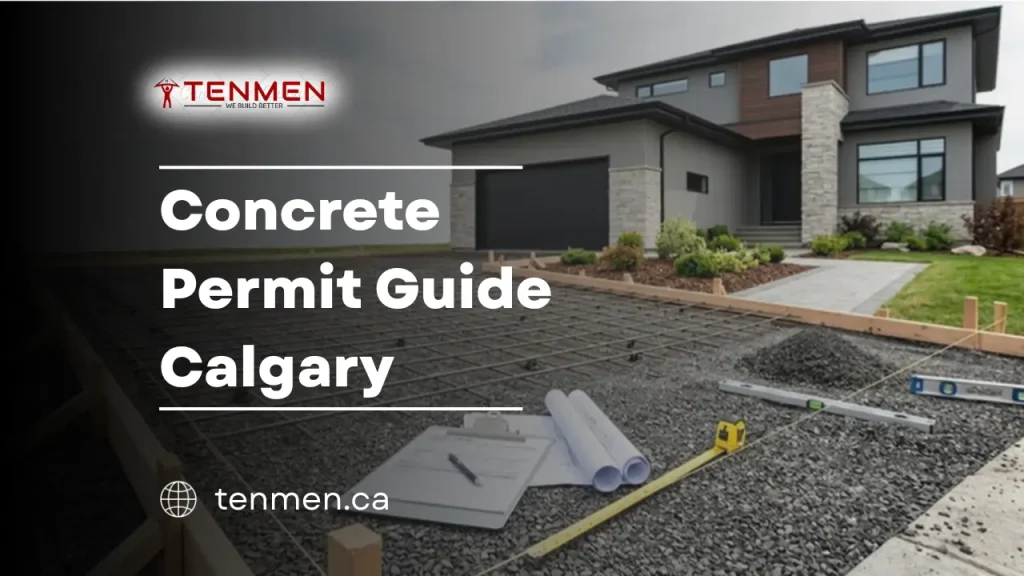
Before you pour new concrete in Calgary, one of the first questions homeowners ask is whether they need a permit. It’s a fair question, and the answer is not always a simple yes or no. It depends on what you’re building, whether you’re replacing existing concrete or creating something new, and where exactly on your property the work is happening.
Getting this wrong can be costly. Some homeowners have had to tear out freshly poured concrete because it didn’t meet City of Calgary development requirements. Others have sold their homes only to run into issues during title transfer because an unpermitted structure showed up on the property survey. Neither situation is fun, and both are avoidable with a bit of planning upfront.
This guide covers the most common residential concrete projects in Calgary, including driveways, garage pads, patios, walkways, and steps, and breaks down when you should be checking with the City before the concrete truck rolls up.
Do You Need a Permit to Replace or Widen a Concrete Driveway in Calgary?
This is the question we get most often, and it comes in a few different forms: “I want to replace my crumbling driveway,” or “I want to add a second parking pad beside my existing one,” or “Can I widen my driveway to fit three cars?”
Each of those scenarios is different from a permit standpoint.
Replacing an Existing Driveway
Replacing a driveway that already exists, same location, same footprint, is typically the simplest case. The City of Calgary generally does not require a development permit for a straight replacement of an existing driveway. That said, you should still confirm with the City directly before starting, because conditions and land use bylaws can vary depending on your community, lot type, and whether your property has any outstanding variances or overlays.
What does matter in a replacement project is the quality of the work. Calgary’s clay-heavy soil and freeze-thaw climate punish shortcuts. If the base isn’t properly compacted, if drainage isn’t graded away from the house, or if the mix design isn’t appropriate for Alberta winters, you’ll be back in the same situation in five to eight years. Our concrete driveways page covers more on what a proper Calgary driveway installation involves.
Widening or Extending an Existing Driveway
This is where things get more involved. According to the City of Calgary, extending or widening an existing driveway may require planning approval or a development permit. Widening typically changes your site’s hard-surface coverage, which is regulated to manage stormwater runoff across the city. Increasing the width of a driveway along a street or lane-access lot can trigger a review.
Homeowners often assume widening is a small change. From a permitting standpoint, it may not be. Check with the City’s planning department or 311 before breaking ground.
Building a New Driveway
If you’re adding a driveway to a property that doesn’t currently have one, or creating a second access point, you’ll almost certainly need a development permit. New driveway access affects curb cuts, boulevard grading, utility clearances, and how your property interacts with city infrastructure. The City’s review process exists for good reasons here.
Lane-access lots (common in many inner-city Calgary neighbourhoods) have their own set of rules about where driveways can be placed and how wide the opening can be relative to your rear property line.
When in doubt, a quick call to the City of Calgary’s planning department or a chat with an experienced Calgary concrete contractor can save you a lot of headache.
Do Concrete Garage Pads in Calgary Need Permit Planning?
A garage pad by itself is a slab of concrete. But in most cases, the reason you’re pouring a garage pad is because you’re building a garage on top of it, and that changes everything.
The City of Calgary requires a residential improvement project permit when constructing or renovating a detached garage or accessory residential structure. If your garage project also involves gas, electrical, or plumbing rough-ins, additional trade permits are required for each of those disciplines.
Plan the Pad With the Garage in Mind
One of the most common mistakes we see is homeowners pouring a concrete pad before the garage drawings are finalized. Then the structural engineer or garage company comes out and tells them the slab thickness, anchor bolt placement, or perimeter footing doesn’t match the building design. Sometimes the whole slab has to come out.
A proper concrete garage pad should be designed around the structure going on top of it. That means knowing the garage’s intended use (single or double car, RV storage, heated workshop), the span of the walls, whether a vehicle hoist will be installed, and how floor drains will tie into the site drainage. These details affect slab thickness, reinforcement layout, and whether a thickened perimeter edge is needed.
On-Site Drainage and Grade
Calgary’s grade requirements for accessory structures are also worth understanding early. Water must drain away from all structures and away from adjacent properties. If you pour a pad that creates a low spot or channels water toward a neighbour’s yard, that’s a problem the City takes seriously. Getting your drainage slope right at the time of the pour is far easier than trying to fix it afterward.
What About Concrete Patios, Walkways, and Backyard Pads?
For many straightforward flatwork projects in a backyard, the permitting picture is simpler. A basic ground-level concrete patio, an interior walkway, or a backyard pad often does not require a development permit on its own.
That said, “basic” has a specific meaning here.
When a Patio Stays Simple
A ground-level concrete slab in your backyard, properly graded away from the house, not attached to the structure, and not affecting drainage patterns, is generally in the clear from a permit standpoint. The same applies to most concrete sidewalks on private property and lower-profile concrete patios that sit flush with grade.
When a Patio Gets More Complex
The moment your project involves any of the following, you should be checking with the City:
- Retaining walls over a certain height (rules vary by community)
- Raised decks or elevated slabs that are attached to the house
- Covered patio structures or pergolas with roofing
- Fencing or privacy walls built on the slab perimeter
- Concrete steps connecting to the house’s main entry or affecting egress
- Significant grade changes that alter how water drains across your lot
Concrete steps and stairs connected to a home’s primary entry point in particular are worth reviewing, since they affect exit safety. Calgary’s building code has specific requirements around riser height, tread depth, and handrail requirements for exterior stairs.
For drainage, the rule of thumb is simple: water should never pool against your foundation. Every concrete surface on your property should have a minimum slope of 2 percent (roughly 1/4 inch per foot) draining away from the house. If you’re not sure whether your current grade achieves that, a site visit with a contractor who knows Calgary’s clay soils is worth the time.
Common Permit and Planning Mistakes Before Pouring Concrete
After pouring driveways, pads, and patios across Calgary and Airdrie, we’ve seen the same planning mistakes come up repeatedly. Most of them are avoidable.
Assuming All Concrete Work is Permit-Free
This is the big one. A lot of homeowners assume that because concrete is just a slab sitting on the ground, it doesn’t need any approval. That’s sometimes true and sometimes not, and getting it wrong is expensive.
Widening a Driveway Without Checking First
Driveway widening is one of the most common unpermitted projects we see. It seems minor but can affect boulevard integrity, utility setbacks, and surface drainage compliance.
Pouring Too Close to Property Lines
Calgary’s land use bylaw specifies minimum setbacks for hard surfaces and structures from property lines. These vary by zone. A slab poured too close to a fence line might need to be removed.
Poor Drainage Planning
Concrete is permanent. Once it’s in, redirecting drainage is a major job. Always ensure your contractor accounts for where water will go before a single yard of concrete is placed.
Ignoring Underground Utilities
Alberta One-Call (also known as Click Before You Dig) is a mandatory step before any excavation in Alberta. Missing underground utilities during base excavation causes serious safety risks and expensive repairs.
Choosing the Wrong Finish for Calgary Winters
A smooth, hard-trowelled concrete surface looks great in a showroom but gets dangerously slippery when icy. Calgary winters demand surface finishes that provide traction. Broom finish concrete is the standard for exterior residential surfaces for exactly this reason. Exposed aggregate is another popular option that combines grip with good looks.
Hiring Based Only on Price
A concrete contractor who skips proper base prep, uses a non-air-entrained mix, or pours in unsuitable weather conditions will produce work that fails faster. Calgary’s freeze-thaw cycles are relentless, and substandard concrete absorbs water, cracks, and spalls within a few years. Proper base depth, reinforcement, and mix design are non-negotiable in this climate.
How Tenmen Construction Helps Homeowners Plan Concrete Projects Properly
Planning a concrete project in Calgary or Airdrie involves more than picking a finish colour. Base prep, drainage, mix design, permit awareness, and proper reinforcement all have to work together for the slab to last decades instead of years.
At Tenmen Construction, we work with homeowners across Calgary, Airdrie, Chestermere, Cochrane, and Okotoks on exactly these kinds of projects. Whether you’re replacing a cracked driveway, adding a garage pad for a new build, or redoing your backyard patio, we start every project with a free on-site estimate that covers scope, drainage, access, and finish options specific to your property.
Our crews are experienced with Alberta’s demanding climate. We use proper air-entrained concrete mixes, install appropriate rebar and control joints, and grade every surface for drainage before the first truck arrives. We’ll also flag any permit questions you should be raising with the City before work starts so there are no surprises after the pour.
Our concrete services include:
- Concrete driveways (replacement, widening, new pours)
- Concrete garage pads (standard and heavy-duty)
- Concrete patios (ground-level flatwork and decorative finishes)
- Concrete sidewalks and walkways
- Concrete steps and stairs (front entry, side access, backyard)
- Decorative finishes including stamped concrete, exposed aggregate, coloured concrete, and broom finish
Ready to get your project planned properly? Call Tenmen Construction at (825) 882-9406 for a free on-site estimate with transparent, line-item pricing. We’ll walk the site with you, answer your questions, and tell you exactly what your project involves before any commitment is made.
Contact Tenmen Construction today and get your project started the right way.