If you’ve got a driveway, patio, or walkway with cracks running through it, you’ve probably already searched “can this be fixed or do I need a whole new slab.” It’s one of the most common questions we hear on jobsites across Calgary and Airdrie, especially after a hard winter.
The honest answer is that it depends on what’s happening underneath the concrete, not just what you can see on the surface. A hairline crack might be cosmetic. A crack with one side higher than the other usually means something has shifted below, and patching it won’t fix the real problem.
This article walks through how to tell the difference between concrete that can be repaired, concrete that needs resurfacing, and concrete that’s due for full replacement, so you can make a smart decision before calling a concrete contractor in Calgary.
Why Calgary’s Climate Makes This Decision Tricky
Calgary sees some of the most dramatic temperature swings in the country. A chinook can push temperatures from minus 20 to plus 10 in a single afternoon, and that constant freeze-thaw cycling is brutal on concrete.
Water gets into even tiny cracks, freezes, expands, and widens the crack a little more each cycle. Over a few winters, a small crack can turn into a major one. This is why a repair that looks fine in August can fail again by the following spring if the underlying cause wasn’t addressed.
Clay soil is another factor. A lot of Calgary and Airdrie neighborhoods sit on clay-heavy soil that expands when wet and contracts when dry. That movement is one of the biggest reasons slabs heave, settle unevenly, or develop cracks that keep coming back.
Minor Surface Repairs: When a Patch Job Makes Sense
Not every crack or chip means trouble. Some damage is purely cosmetic and can be addressed without touching the structure of the slab.
Surface repairs are usually appropriate for:
- Hairline cracks that don’t run through the full depth of the slab
- Small surface chips or flaking from old deicing salt damage
- Minor scaling on the top layer of an otherwise solid driveway or patio
- Pop-outs caused by aggregate near the surface reacting to moisture
These repairs involve cleaning out the damaged area, filling with a proper concrete patching compound or polymer-modified repair mortar, and finishing it to blend with the surrounding surface. On most Calgary jobsites, we see this kind of repair hold up well for years, as long as the slab itself is structurally sound.
The key word there is structurally sound. If the slab underneath is solid and level, and the damage is genuinely surface-level, a patch is a reasonable, cost-effective fix.
Crack Repair vs. Crack Injection: What’s the Difference
Cracks are the number one reason homeowners call us, and not all cracks are treated the same way.
Routing and Sealing
For cracks that are stable (not actively widening or shifting) and mostly cosmetic, routing and sealing is a common approach. This involves widening the crack slightly with a saw, cleaning it out, and filling it with a flexible sealant designed to handle Alberta’s temperature swings.
This won’t make the crack disappear, but it stops water from getting in and doing further freeze-thaw damage. It’s a maintenance step, not a cosmetic fix.
Epoxy or Polyurethane Injection
For structural cracks, meaning cracks that go through the full depth of the slab, injection repairs can bond the two sides back together. This is more involved and typically used on foundation walls or structural slabs rather than driveways, since driveway cracks are usually caused by ongoing ground movement that injection alone won’t solve.
If a crack keeps reopening in the same spot year after year, that’s usually a sign the ground below is still moving, and a cosmetic fix won’t hold.
Concrete Resurfacing: A Middle-Ground Option
Resurfacing involves applying a new layer of concrete, polymer overlay, or specialized topping over an existing slab. It’s often marketed as a budget alternative to replacement, and in the right situation, it genuinely is.
Concrete resurfacing in Calgary can work well when:
- The existing slab is structurally sound with no major settling
- Cracking is limited to surface-level and not actively progressing
- The slab has good drainage and proper slope away from the home
- The homeowner wants to update the appearance (for example, going from plain broom finish to a stamped concrete or exposed aggregate look)
Where resurfacing falls short is when it’s used to cover up problems instead of fixing them. We’ve seen driveways resurfaced over slabs with drainage issues or base failures, and within a couple of years, the same cracks come right back through the new layer. Resurfacing follows whatever is happening underneath it. It doesn’t fix a bad base.
Warning Signs That Point to Replacement, Not Repair
This is where a lot of homeowners get stuck, because some of these signs aren’t obvious unless you know what to look for. After pouring hundreds of driveways, patios, and walkways across Calgary and Airdrie, these are the red flags that almost always mean repair won’t be a lasting fix.
Deep or Spreading Cracks
A crack that’s wider than about a quarter inch, or one that’s noticeably wider at one end than the other, usually means the slab has shifted. Patching the surface won’t stop that movement.
Sinking or Settling Slabs
If part of your driveway, patio, or walkway has dropped relative to the rest, that section has lost support from below. This is common where the base material wasn’t compacted properly during the original install, or where water has washed out the base over time.
Major Spalling and Surface Breakdown
Spalling is when chunks of the concrete surface flake or break away, often exposing the aggregate underneath. Light spalling can sometimes be resurfaced, but widespread or deep spalling usually means the concrete itself has been compromised by years of moisture intrusion and freeze-thaw cycling.
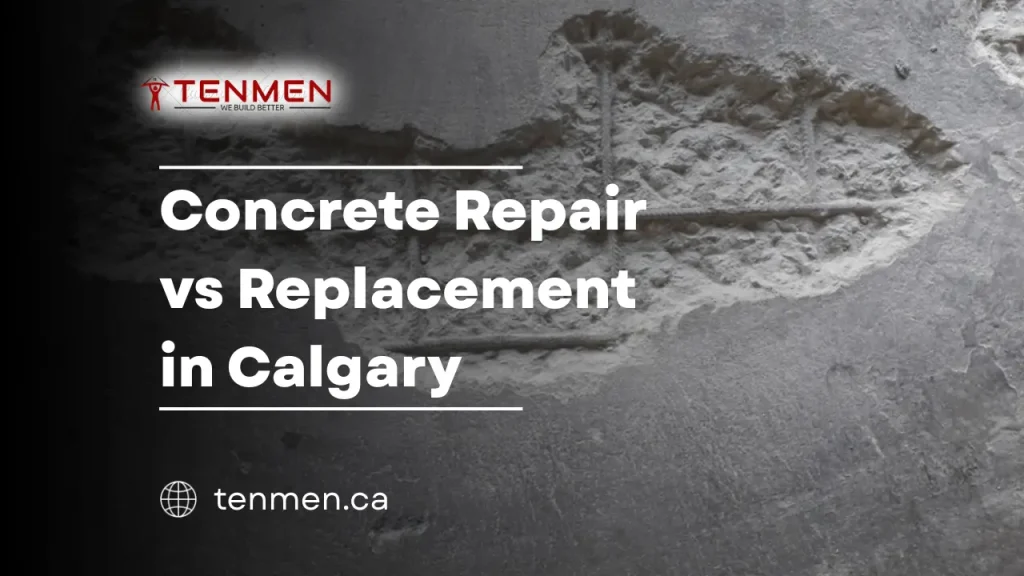
Exposed Rebar
If you can see steel reinforcement showing through cracks or spalled areas, that’s a serious sign. Once rebar is exposed to moisture and starts rusting, it expands and accelerates the breakdown of the surrounding concrete. This is one of the clearest signals that a section needs to come out.
Drainage and Pooling Issues
If water consistently pools on your driveway or patio instead of draining away, the slope was either poured incorrectly or has shifted due to settling. Repairing cracks without correcting the slope just means new cracks will form in the same spots, because the underlying water problem hasn’t gone away.
Multiple Failed Repairs in the Same Area
If you’ve patched the same crack or section more than once and it keeps coming back, that’s the ground telling you something. At that point, a full driveway replacement or garage pad replacement is usually more cost-effective long term than another round of patching.
How We Assess Repair vs. Replacement On-Site
When we show up for a free estimate, the first thing we look at isn’t just the visible damage. It’s what’s happening below the surface and around the slab.
A proper assessment includes:
- Tapping and sounding the slab to check for hollow spots, which can indicate voids underneath from washed-out base material
- Checking slope and drainage around the entire perimeter, not just near the cracks
- Measuring crack width and pattern to determine whether movement is ongoing or has stabilized
- Looking at the age and history of the slab, including any past repairs
- Assessing the base material, where possible, especially on older properties where original prep may not meet today’s standards
One of the most common mistakes homeowners make is focusing only on the crack itself and missing the bigger picture, like a downspout draining directly onto the slab edge, or a slope that pushes water back toward the foundation.
Partial Replacement: When You Don’t Need to Redo Everything
Full replacement doesn’t always mean tearing out your entire driveway or patio. In many cases, only a section of the slab is failing, while the rest is in good shape.
Partial replacement involves cutting out the damaged section along expansion joints or control joints, removing and replacing the base material underneath if needed, and pouring a new section that matches the existing finish.
This approach makes sense when:
- The damage is isolated to one section (such as where a tree root has caused heaving, or where a downspout has saturated the base)
- The rest of the slab is structurally sound and properly sloped
- The new section can be matched reasonably well in finish and colour
The trade-off is that a new pour will always look slightly different at first, especially with finishes like coloured concrete or broom finish, though this becomes less noticeable as the new concrete weathers over a season or two.
Cost Factors: Repair, Resurfacing, or Replacement
Pricing depends heavily on the scope of the problem, but here’s generally how the options compare in terms of investment:
- Surface repairs and crack sealing are the lowest-cost option, often a few hundred dollars depending on the area covered
- Resurfacing typically costs less than full replacement but more than basic crack repair, and pricing depends on the finish chosen
- Partial replacement depends on the size of the section, accessibility, and whether base work is needed
- Full replacement is the largest investment but resets the clock on the entire slab, including the base, which is often where the real value is
A driveway that keeps needing repairs every year or two can end up costing more over time than one full replacement would have. If you’re curious what a full driveway redo runs in this market, our breakdown on concrete driveway costs in Calgary goes into more detail.
When Repair Is Just Delaying the Inevitable
Here’s something experienced concrete finishers know that not every homeowner realizes: if the base or drainage is the actual problem, no surface-level repair is permanent. It might look good for a season or two, but the underlying movement is still there.
This doesn’t mean repair is a waste of money in every case. Sometimes a repair genuinely buys you several more years of life from a slab, especially if the damage is isolated and the base is otherwise sound. But if you’re dealing with a slab that’s already shown multiple warning signs (sinking, major spalling, exposed rebar, repeated cracking), spending money on repairs is often just delaying a replacement that’s coming either way.
If you want to understand how long concrete typically lasts in this climate and what affects that lifespan, our article on how long concrete lasts in Calgary breaks down the factors involved. And if you’re trying to stay ahead of winter damage on an existing driveway, protecting your driveway from winter cracks covers some practical maintenance steps.
Get a Straight Answer With a Free On-Site Assessment
If you’re staring at cracks in your driveway, patio, or walkway and aren’t sure whether it’s a quick fix or a bigger job, the best way to know for sure is to have someone look at it in person. Photos and descriptions only tell part of the story, especially when the real issue is happening below the surface.
Tenmen Construction offers free on-site estimates for homeowners across Calgary, Airdrie, Chestermere, Cochrane, and Okotoks. We’ll give you a straightforward assessment of what’s actually going on with your concrete, walk you through whether repair, resurfacing, or replacement makes the most sense, and provide transparent, line-item pricing so you know exactly what you’re paying for.
No pressure, no upselling, just an honest opinion from people who’ve worked on driveways, patios, and garage pads throughout this region for years. Call us today at (825) 882-9406 or reach out through our contact page to book your free assessment.