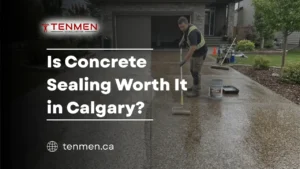
Every spring, homeowners walk out to the driveway after the snow melts and notice something has changed. The exposed aggregate that used to look rich and glossy now looks chalky. The stamped patio has faded. Water that used to bead up now soaks straight in and leaves dark patches. That usually leads to the question of how often the concrete should be sealed.
There isn’t one fixed schedule. How often to seal concrete in Calgary depends on the type of sealer on the surface, how much traffic it gets, how exposed it is to sun, snow and de-icing salt, how well the last coat was applied, and how quickly that coat is wearing. A shaded back patio might go years between coats. A south-facing driveway that handles two vehicles and a winter of salty slush can need attention much sooner.
This guide covers what sealer actually does and how our climate wears it down. It also explains the signs that it’s time to reseal and the situations where a fresh coat won’t solve the real problem.
Why Concrete Is Sealed in the First Place
Concrete is porous. It absorbs water, oil, salt brine and anything else that sits on it. Sealer reduces how much of that gets in.
A good sealer helps to:
- Reduce water and salt absorption, which lowers the stress freeze-thaw cycles put on the surface
- Make oil, grease and dirt easier to clean before they soak in
- Protect the colour of stamped and coloured concrete from UV fading
- Enhance and preserve the look of exposed aggregate and other decorative finishes
Sealer doesn’t make concrete indestructible. It won’t stop cracks caused by soil movement or fix a poorly built base, and it won’t make a surface immune to salt or freeze-thaw damage. It lowers the risk. You can see how we approach it on our concrete sealing page.
How Calgary and Airdrie Weather Affects Sealed Concrete
Few climates are harder on exterior concrete than ours. Between fall and spring, surfaces can cross the freezing point again and again, sometimes more than once in a single day when a chinook rolls through. Water inside the concrete expands each time it freezes. Sealer helps keep that water out, but the constant cycling also wears down the sealer itself.
Other factors add to the wear:
- De-icing salt comes in on tires and sits in brine puddles on driveways and garage aprons for weeks
- Snow shovels and ice scrapers scuff film-forming sealers, especially on walkways
- Strong summer sun breaks down some sealers faster than homeowners expect
- Clay soil movement can open hairline cracks that let water get beneath the coating
On most jobsites, we see the heaviest sealer wear in the same places: where tires turn, where water pools, and in front of the garage door where slush drips off vehicles all winter. Our article on protecting your driveway from winter cracks goes deeper into cold-season care.
Penetrating vs. Film-Forming Sealers in Plain Language
The resealing question is much easier to answer once you know which type of sealer you have.
Penetrating Sealers
Penetrating sealers soak into the concrete and react inside the pores. Silane and siloxane products are common examples. They don’t leave a shiny coating and barely change the look of the surface. Because they work below the surface, they don’t peel or scuff off the way a coating does, and they generally last longer between applications. The tradeoff is that they won’t enhance colour or give a wet look.
Film-Forming Sealers
Film-forming sealers, such as acrylics and other high-gloss products, sit on top of the concrete as a thin protective layer. They’re popular on stamped concrete and exposed aggregate because they deepen colour and give that wet look. They wear faster because tires, shovels and sun act directly on the film. On a busy driveway, expect to reseal every few years rather than going a long stretch between coats.
If you don’t know what was used on your concrete, your original installer may have records. An experienced contractor can usually tell by looking at the surface and watching how water behaves on it.
Signs Your Concrete May Need Resealing
Judge by the condition of the concrete rather than by the calendar. These are the signs we look for.
Fading or Loss of Colour
Stamped or coloured concrete that looks washed out, especially in sunny areas, is often losing its protective layer. Patchy colour loss usually points to worn sealer.
Reduced Water Repellency
This is the easiest test. Sprinkle some water on the surface. If it beads up, the sealer is still doing its job. If the concrete darkens and absorbs the water within a minute or so, the protection has worn down. Test several spots, including the high-traffic areas.
Dull Appearance
Exposed aggregate that has lost its shine and looks grey or dusty is a classic sign that a film sealer has broken down.
Uneven Wear
When half the driveway still looks sealed and the other half doesn’t, that’s usually a normal wear pattern rather than a bad product. It means the traffic lanes need attention before the rest of the slab.
High-Traffic Areas
Tire paths, the garage apron, steps and the path from the driveway to the front door almost always wear first. These spots will show you when resealing is due.
Driveways, Patios, Walkways and Exposed Aggregate Wear Differently
Driveways take the most punishment from vehicle weight, turning tires, salt brine and snow clearing. They usually need resealing before anything else on the property.
Patios get less traffic but more sun, plus furniture scraping, BBQ grease and planter stains. A partly shaded backyard patio can often go noticeably longer between coats than the driveway at the same house. Many patios are stamped concrete, where the sealer carries much of both the look and the colour protection.
Walkways get steady foot traffic and a lot of shovelling, so film sealers get scuffed quickly. Watch for traction too. Glossy sealers can be slippery when wet unless an anti-slip additive is mixed in.
Exposed aggregate relies on sealer more than most finishes. The sealer deepens the colour of the stones and helps protect the paste holding them in place. Once the surface goes dull, it’s usually time to reseal.
Should You Seal Every Year?
Usually not. Resealing every year “just to be safe” can cause problems with film-forming sealers. Each coat adds thickness, and too much build-up can lead to a cloudy, whitish finish, trapped moisture, peeling and a slippery surface.
A better habit is to check your concrete every spring, do the water test, and reseal when the surface shows it needs it. Some years that means sealing only the driveway. Some years it means doing nothing at all.
Why Surface Preparation Matters Before Another Coat
One of the most common mistakes homeowners make is rolling new sealer over a dirty or failing surface. The new coat only bonds as well as the surface underneath it.
Proper prep usually includes:
- Thorough cleaning to remove dirt, oil and salt residue
- Treating oil stains so the sealer can bond
- Letting the concrete dry fully after washing
- Removing any loose, flaking or peeling sealer
Don’t Seal Over a Failing or Incompatible Coating
If the old sealer is peeling, flaking or has turned white and cloudy, a new coat on top usually traps the problem underneath. The new layer can then peel off along with the old one.
Compatibility matters too. Some water-based sealers don’t bond well over solvent-based products, and the reverse can also be true. Mixing them can cause poor adhesion and patchy results. In those cases, the old coating may need to be stripped before resealing. When we assess an existing surface, the first thing we try to identify is what’s already on it.
Best Time of Year to Seal Concrete in Calgary
The general window is late spring through early fall. Late summer and early September often work best because surfaces are dry, days are warm, and the new protection is in place before salt season starts. If you wait too far into fall, cold nights can stop the sealer from curing properly.
Weather Conditions That Matter During Application
- Air and surface temperatures within the manufacturer’s range and staying there overnight (many products call for roughly 10°C or warmer)
- No rain in the forecast for at least 24 hours
- Fully dry concrete, with no recent washing or heavy morning dew
- No hot midday sun on dark surfaces, because solvent-based sealers can bubble when the concrete is too warm
- Calm conditions, so dust and debris don’t blow into the wet sealer
New concrete also needs time to cure before its first sealing. That’s often around a month, but the right timing depends on the product.
When Resealing Isn’t the Right Solution
Sealer is maintenance, not repair. It won’t fix:
- Structural cracking, such as wide cracks, cracks where one side sits higher than the other, or sections that have heaved or sunk
- Serious surface failure, including widespread spalling, scaling, or stones popping loose
- Moisture problems, such as poor drainage pushing water toward the slab or moisture rising from below and repeatedly whitening the sealer
If you’re seeing any of these, get a professional assessment first. Sometimes repairs make sense, and sometimes replacement is the better investment. Our guide on how long concrete lasts in Calgary can help put that decision in context.
Checklist: Does My Concrete Need Resealing?
Walk your driveway, patio and walkways and ask yourself:
- Does water soak in instead of beading up?
- Has the colour faded, especially in sunny spots?
- Does the exposed aggregate look dull, grey or chalky?
- Are the tire paths or entry areas noticeably more worn than the rest?
- Is the existing sealer peeling, flaking or turning white?
- Are there wide cracks, heaving sections or crumbling surface areas?
If you answered yes to any of the first four, resealing is probably due. If either of the last two applies, get the surface looked at before buying sealer.
Frequently Asked Questions
How often should exposed aggregate be sealed?
There’s no set interval. Exposed aggregate usually has a film-forming sealer, so it tends to need resealing more often than concrete protected with a penetrating product. Reseal when the stones look dull or water stops beading.
Can you reseal concrete too often?
Yes. With film-forming sealers, extra coats build up thickness. That can cause cloudiness, peeling and a slippery surface.
Can old concrete be sealed again?
Usually, as long as the concrete is structurally sound and properly cleaned. Any existing coating has to be compatible with the new sealer or removed first.
Does concrete need to be cleaned before sealing?
Always. Sealing over dirt, oil or salt residue locks it in and weakens the bond.
Can concrete be sealed before winter?
Yes, as long as there’s still a stretch of warm, dry weather for application and curing. Aim for early fall rather than the last few weeks before freeze-up.
How long does concrete sealer take to dry?
It depends on the product and the weather. Many sealers are dry to the touch within a few hours. Foot traffic usually waits until the next day, and vehicles may need a few days. Always follow the manufacturer’s guidance.
Have Your Concrete Assessed Before You Reseal
If your driveway, patio or exposed aggregate is starting to look tired, another coat isn’t always the answer. Sometimes the surface needs a proper clean and reseal. Sometimes a failed coating has to be stripped first. And sometimes the concrete has problems that sealer can’t fix.
Tenmen Construction helps homeowners across Calgary and Airdrie assess existing concrete and recommends only what the surface actually needs. Estimates are free and done on-site, with transparent, line-item pricing so you know exactly what you’re paying for. Call (825) 882-9406 to book an assessment.