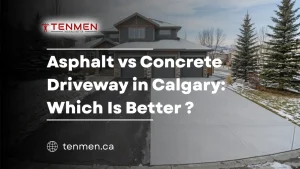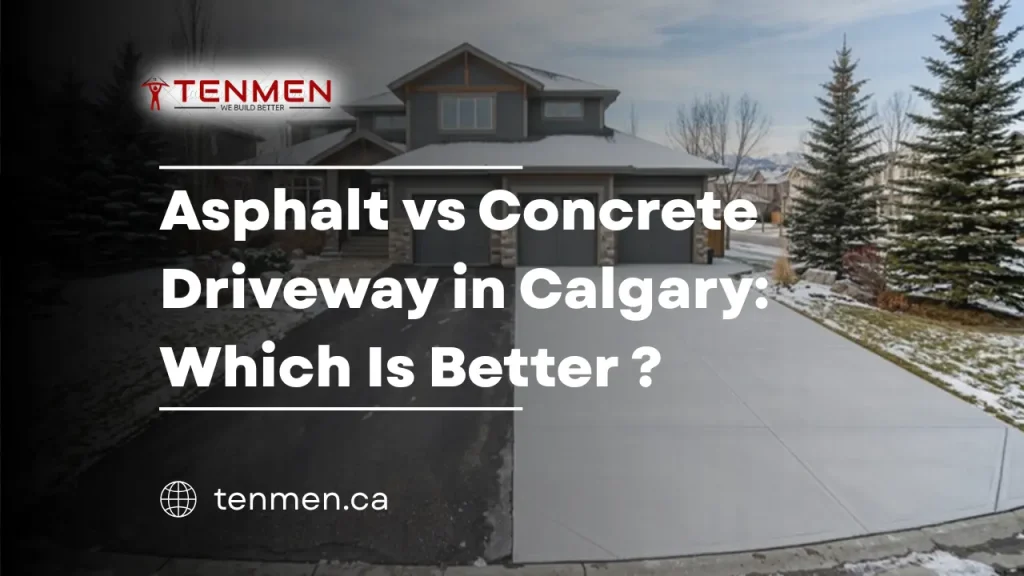
Every few years, a homeowner in Calgary or Airdrie asks us the same question after watching their asphalt driveway crumble apart faster than they expected: should they replace it with more asphalt, or switch to concrete this time? It’s a fair question, and the honest answer depends on what you actually want out of a driveway over the next 20 to 30 years, not just what costs less to install today.
Alberta’s climate is brutal on driveways. Clay soil expands and contracts with moisture, freeze-thaw cycles run through the surface dozens of times each winter, and chinook winds can push temperatures up 20 or 30 degrees in an afternoon before plunging back down overnight. That kind of thermal whiplash puts real stress on whatever material is under your tires, and asphalt and concrete respond to it very differently.
This article breaks down how the two materials actually perform here, not in a generic climate, but in ours. Lifespan, winter behaviour, cracking, maintenance, cost, and what each one does for your property’s curb appeal and value.
Lifespan: How Long Each Material Actually Lasts
Asphalt has a shorter functional life than most homeowners expect going in. In Calgary’s climate, a well-installed asphalt driveway typically holds up for 15 to 20 years before it needs full replacement, and that’s assuming regular sealcoating and crack filling along the way.
Concrete, when it’s poured correctly with proper base prep, rebar reinforcement, and an air-entrained mix built for freeze-thaw conditions, routinely lasts 30 years or more. After pouring hundreds of driveways across Calgary and Airdrie, we’ve seen concrete driveways from the 1990s that are still structurally solid today, just showing normal surface wear. That’s the kind of longevity gap that changes the math on which material actually costs less over time.
Winter Performance: Where the Difference Really Shows
This is the category that matters most if you’re weighing driveway paving Calgary options with our winters specifically in mind.
Asphalt is a dark, heat-absorbing material, which sounds like an advantage in January. It does melt light snow and frost faster than concrete on sunny days. But that same heat absorption becomes a problem during freeze-thaw cycles, because asphalt softens slightly in warmth and then hardens again as temperatures drop, and repeated softening and hardening accelerates surface breakdown over the season.
Concrete holds its shape far more consistently across temperature swings. It doesn’t soften in the sun the way asphalt does, and a properly reinforced slab is built specifically to resist the expansion and contraction that comes with freeze-thaw. Experienced concrete finishers know that this stability is exactly why concrete outperforms asphalt in regions like ours, where the freeze-thaw cycle runs dozens of times each winter instead of just a handful.
Cracking and Surface Damage
Asphalt cracking is almost a guarantee over its lifespan. Small cracks show up within the first several years, and if they’re not sealed quickly, water gets underneath, freezes, and expands the crack further. Left unmanaged, this turns into potholes and alligator cracking, especially in driveways with heavier vehicle traffic.
Concrete isn’t immune to cracking, but the type of cracking is different and generally more manageable. Hairline cracks from normal curing are common and mostly cosmetic. Serious cracking usually only happens when the base wasn’t compacted properly or control joints weren’t placed correctly, which is why proper site prep is something a lot of contractors skip, but it’s the single biggest factor in whether a concrete driveway stays crack-free for decades. We go into more detail on this in our guide to protecting your driveway from winter cracks.
Maintenance: What Each Surface Actually Requires
Asphalt Maintenance
- Sealcoating every 2 to 3 years to protect against UV exposure and moisture
- Crack filling as soon as cracks appear, before winter sets in
- Periodic patching in high-wear areas near the garage entrance
- Full resurfacing typically needed within 10 to 15 years
Concrete Maintenance
- Sealing every 2 to 3 years, similar interval to asphalt but a much simpler process
- Occasional crack monitoring, with minor repairs as needed
- No resurfacing required for decades under normal use
The maintenance schedules look similar on paper, but concrete requires less intervention per cycle and holds up longer between major work. Our concrete sealing service is one of the most cost-effective things a homeowner can do to stretch a driveway’s lifespan even further.
Heat Resistance and Summer Performance
Calgary summers aren’t as extreme as some regions, but asphalt still softens noticeably on hot, sunny days, which can lead to tire marks, ruts under parked vehicles, and a driveway that feels sticky underfoot in July. Concrete stays rigid regardless of surface temperature, so you don’t get the same soft-surface issues during heat waves.
Snow Clearing and Everyday Practicality
Both materials clear reasonably well with a shovel or snowblower, but concrete’s lighter, more reflective surface tends to hold less residual ice after a clear, and its consistent flat surface (assuming proper grading) reduces the chance of pooling water that refreezes into black ice. Asphalt’s darker surface can actually work in its favour on sunny days by melting snow faster, but that advantage disappears on overcast days, which Calgary has plenty of through the winter months.
Cost: Upfront Price vs Long-Term Value
Asphalt is almost always cheaper to install upfront, which is why it’s still a popular choice for homeowners working with a tighter budget. But the total cost of ownership tells a different story once you factor in sealcoating, crack repairs, and the eventual full resurfacing that asphalt requires roughly every 15 years.
Concrete costs more at installation, but the extended lifespan and lower frequency of major repairs usually make it the better long-term value, especially if you’re planning to stay in your home for more than a decade. If you want a clearer breakdown of what goes into concrete pricing here, our article on concrete driveway costs in Calgary walks through the main cost factors.
Curb Appeal and Property Value
Asphalt has a uniform, plain black appearance, which some homeowners like for its clean, understated look. But it doesn’t offer much room for customization beyond that.
Concrete gives you far more flexibility. Beyond a standard broom finish, you can go with stamped concrete for a pattern that mimics natural stone, or exposed aggregate for texture and a more premium look. One of the most common mistakes homeowners make is assuming concrete only comes in one plain grey finish, when in reality it’s one of the more customizable driveway materials available. That flexibility, combined with its longer lifespan, is a big part of why concrete driveways tend to be viewed as a premium upgrade during a home appraisal or sale.
So Which One Actually Makes Sense for Calgary and Airdrie Homes?
If upfront cost is the only factor, asphalt will win that comparison. But when you weigh lifespan, freeze-thaw performance, maintenance demands, and how each material affects resale value, concrete comes out ahead for most Calgary and Airdrie homeowners planning to stay put for more than a few years. It’s built to handle exactly the kind of climate stress our winters throw at it, and it does so with less recurring maintenance than asphalt requires.
Talk to a Calgary Concrete Crew Before You Decide
Choosing between asphalt and concrete is a decision that affects your property for decades, not just the next winter. If you’re weighing your options for a new driveway or replacing an aging asphalt surface, our concrete driveway services page covers exactly what goes into a properly built, freeze-thaw-resistant driveway.
Tenmen Construction offers free on-site estimates with transparent, line-item pricing, so you can compare your options with real numbers instead of guesswork. Call us at (825) 882-9406 and we’ll walk your property, answer your questions honestly, and help you figure out which material actually makes sense for your home.