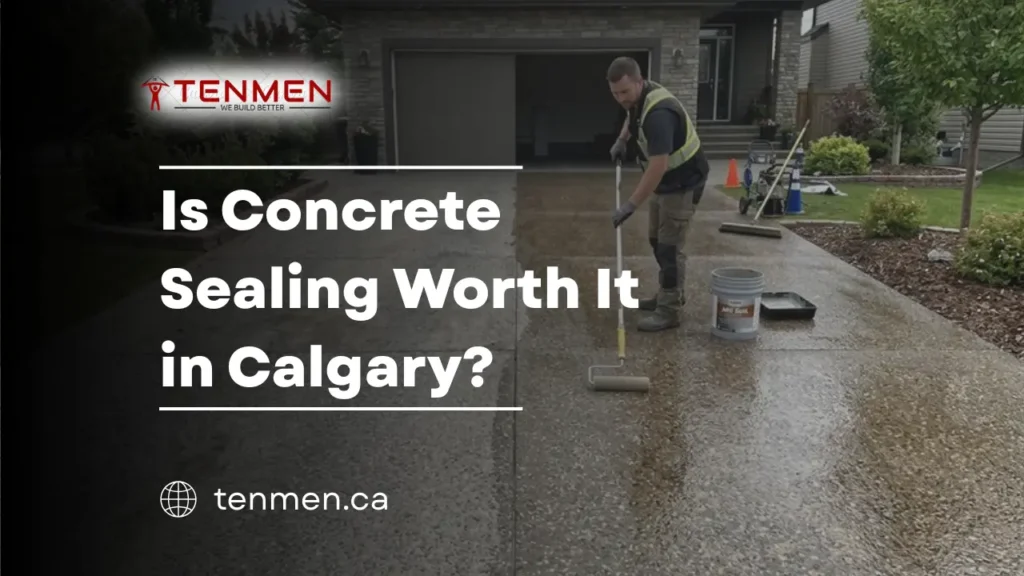
Maybe your exposed aggregate driveway has gone flat and grey. Maybe the stamped patio you loved five summers ago looks washed out, or a neighbour just had their driveway sealed and it looks new again. So you’re wondering whether sealing is worth paying for or whether it’s mostly cosmetic.
For many homeowners, sealing is a sensible investment. It isn’t the right call for every surface, though, and it won’t fix concrete that’s already failing. Whether sealing is worth it in Calgary depends on the condition of your concrete, the finish you have, how the surface gets used, and what you expect sealer to do.
This guide covers the benefits and the limitations, what affects cost, and how to tell whether your surface is a good candidate. It’s written for homeowners in Calgary and Airdrie with an existing driveway, patio, walkway, stamped surface or exposed aggregate.
What Concrete Sealer Actually Does
Concrete is porous. Left unprotected, it absorbs water, oil, salt brine and whatever else lands on it. A sealer reduces that absorption, either by filling the pores (penetrating sealers) or by forming a thin protective layer on top (film-forming sealers).
Water and Moisture Resistance
This is the main job. Concrete that absorbs less water holds less moisture when temperatures drop below freezing, which lowers the stress on the surface. You can see it working when water beads up instead of soaking in.
Stain Resistance
Oil drips, tire marks, rust from patio furniture, leaves left sitting on the slab and BBQ grease all soak into bare concrete. Sealer slows that absorption and gives you time to clean spills before they set. It resists stains but doesn’t make the surface stain-proof.
Easier Routine Cleaning
A sealed surface releases dirt more easily. On most properties we work on, homeowners notice this first: a hose or a light scrub does more than it used to.
What Concrete Sealer Does Not Do
This is where a lot of expectations go wrong, so here it is plainly.
Sealer does not:
- Stop cracking caused by soil movement, settlement or a poor base
- Repair existing cracks, spalling or heaved sections
- Make concrete immune to salt or freeze-thaw damage
- Fix drainage problems that send water toward the slab
- Last forever (every sealer needs periodic reapplication)
Does Sealing Increase Concrete Lifespan?
Sealing mainly protects the surface. By reducing water and salt absorption, it helps protect the top layer, which is the part that scales and spalls first. That can help a well-built slab stay in good shape longer, but it won’t make up for thin concrete, missing reinforcement or a poorly compacted base. How long a slab lasts depends mostly on how it was built. Our article on how long concrete lasts covers those factors in detail.
How Sealing Can Change the Look of Your Concrete
Appearance is a big part of the decision, and the effect depends on the sealer you choose.
Penetrating sealers barely change the look. The concrete stays natural and matte, which suits plain broom-finish driveways and walkways.
Film-forming sealers can change the surface noticeably. They deepen colour, darken the concrete slightly, and give anything from a subtle satin sheen to a high-gloss wet look.
Why Exposed Aggregate Often Looks Richer After Sealing
Exposed aggregate is where people notice the biggest difference. Over time, the exposed stones lose their colour and turn chalky. A suitable film-forming sealer brings back the depth and variation in the stones, much like they look when wet. It also helps protect the cement paste holding the aggregate in place. That’s why exposed aggregate is usually one of the easiest finishes to justify sealing.
High-Gloss vs Lower-Sheen Finishes
High-gloss sealers give the most dramatic colour boost and a strong wet look. Lower-sheen or satin products enhance colour more quietly and tend to look more natural. Lower-sheen finishes also show scuffs and wear patterns less.
Is High-Gloss Concrete Sealer Right for Every Surface?
No, and it’s worth thinking through before choosing one.
Some homeowners love the rich, glossy look, especially on stamped patios and exposed aggregate driveways. Others find it too shiny and prefer the concrete to look more like concrete. Neither preference is wrong.
Suitability depends on a few things:
- The concrete itself. Decorative finishes gain more from gloss than plain broom finish does.
- The existing coating. A new sealer has to be compatible with what’s already on the surface, or the old coating has to come off first.
- Expected use. Glossy film sealers on steps, walkways and sloped driveways can be slippery when wet, so an anti-slip additive is often a good idea.
- Desired appearance. Seeing a test patch or a finished example helps before committing.
How Calgary Winters Test Sealed Concrete
Our climate is the reason many local homeowners consider sealing in the first place.
Freeze-Thaw Conditions
Chinooks can push temperatures above freezing in the middle of winter, and the cold returns within days. Every cycle freezes any water inside the concrete, and ice expands. Reducing how much water gets in is where sealer earns its keep. It lowers the risk but doesn’t eliminate it.
Snow, Ice and Winter Exposure
Snow piles that melt and refreeze keep the surface wet for weeks. Metal shovel blades and ice chippers also scuff film-forming sealers, especially on walkways and steps. Plastic shovels are easier on the finish.
De-Icing Salts
Sealer reduces salt absorption, but you still need good winter habits. Avoid de-icers containing ammonium nitrate or ammonium sulfate, which attack concrete. Don’t let salty slush from vehicles sit on the driveway all season, and rinse it off on warmer days when you can. For more cold-weather habits, see our tips for protecting your driveway from winter cracks.
Wear From Vehicles and Foot Traffic
Tire paths, the garage apron and the front walk wear first. Film sealers wear away gradually in these areas, so expect them to need attention before the rest of the surface.
Preparation, Coats and Maintenance
A sealer is only as good as the surface it’s bonding to. One of the most common mistakes we see is sealer rolled over dirt, oil or salt residue. It looks fine for a season, then starts peeling or clouding.
Proper preparation usually includes a thorough cleaning, oil stain treatment, removing loose or failing sealer, and letting the concrete dry completely.
Is Two Coats Always Better?
Not always. Some products and surfaces benefit from two thin coats, such as a porous exposed aggregate that absorbs the first coat quickly. Other products are designed for a single application, and too much film build-up can cause cloudiness and peeling. The manufacturer’s specs and the surface condition should decide this, not a blanket rule.
Maintenance After Sealing
Sealing doesn’t make concrete maintenance-free. Plan to:
- Clean the surface periodically and deal with oil spills promptly
- Check water beading each spring
- Touch up high-traffic areas as they wear
- Reseal when the surface shows it’s needed, not on a rigid yearly schedule
Good Candidate for Sealing vs. Repair First
Here’s how we typically sort surfaces when we assess them.
Good candidate for sealing:
- Structurally sound concrete
- Faded decorative finish
- Previously sealed exposed aggregate
- Surface needing a refreshed appearance
- Homeowner wanting easier maintenance
May need repair or replacement first:
- Major cracking
- Significant settlement
- Severe spalling
- Drainage problems
- Failed or peeling incompatible coating
When Sealing an Older Surface Makes Sense
Older concrete can benefit a lot from sealing if it’s solid underneath. A 15-year-old driveway with minor hairline cracks and a tired surface is often a good candidate after a proper cleaning.
When Resealing Beats Replacement
If the slab is level, drains properly and has no major structural cracks, resealing is almost always the more economical choice. It refreshes the appearance and protection without the cost of a full tear-out.
When Sealing Won’t Solve the Problem
If sections have heaved or sunk, if cracks are wide or offset, or if the surface is crumbling across large areas, sealer only puts a shiny coat over a failing slab. In those cases, repair or a new concrete driveway is the honest recommendation.
What Affects the Cost of Concrete Sealing
Prices vary from job to job, so here’s what actually changes the number:
- Size of the surface. More square footage means more material and labour.
- Existing coating. Stripping an old or incompatible sealer adds significant work.
- Cleaning requirements. Heavy oil staining or years of grime take longer to prep.
- Repairs. Crack filling or patching before sealing adds cost.
- Sealer type. Penetrating, acrylic and higher-performance products are priced differently.
- Number of coats. Some surfaces need two, others only one.
- Accessibility. Tight backyards, steps and multi-level patios take more time.
- Decorative finish. Stamped and exposed aggregate surfaces often need more careful application.
A good estimate should break these out so you can see where the money goes.
DIY Sealing vs. Professional Sealing
DIY sealing can work on a small, simple surface if you know what’s already on it, prep it properly and pick a compatible product. Most DIY problems come from skipping the cleaning, applying too thickly, sealing in the wrong weather, or putting a new product over an incompatible old one.
Professional sealing makes more sense when you have decorative concrete, an unknown existing coating, peeling or cloudy sealer, or a large driveway where uneven application would be obvious. It also makes sense when you’d rather have someone confirm the surface is worth sealing before you spend on it. You can learn more about our process on our concrete sealing page.
Frequently Asked Questions
Is concrete sealing worth the cost?
For structurally sound concrete, especially decorative finishes, it usually is. It protects the surface, improves appearance and makes cleaning easier. It isn’t worth it on concrete that needs structural repair first.
Does sealing stop concrete from cracking?
No. Most cracking comes from soil movement, settlement, shrinkage or base problems. Sealer reduces water absorption but won’t prevent structural cracks.
Is high-gloss sealer slippery?
It can be when wet, particularly on steps, walkways and sloped surfaces. An anti-slip additive mixed into the sealer improves traction.
Can exposed aggregate be resealed?
Yes. Exposed aggregate is one of the most commonly resealed finishes. The surface should be cleaned, and the existing sealer should be checked for compatibility first.
How long does concrete sealer last?
It depends on the product, traffic, sun exposure and winter conditions. Penetrating sealers generally last longer between applications than film-forming ones. Watch how the surface behaves rather than counting years.
Can you put new sealer over old sealer?
Sometimes. If the old coating is sound and compatible, a fresh coat can go on after cleaning. If it’s peeling, cloudy or incompatible, it usually needs to be removed first.
Should a concrete driveway be sealed before winter?
Sealing in late summer or early fall is a good plan, as long as the weather stays warm and dry enough for proper curing. Leaving it until late fall risks the sealer not curing properly.
Not Sure What Your Concrete Needs?
The right answer isn’t always a new coat of sealer. Some surfaces need a thorough cleaning, some need resealing, some need repairs first, and some are better off replaced.
If you’re unsure which applies to your driveway, patio or walkway, Tenmen Construction can assess the surface and recommend an appropriate next step for your Calgary or Airdrie property. Estimates are free and done on-site, and pricing is transparent and line-item, so you’ll know what you’re paying for and why. Call (825) 882-9406 to book an assessment.