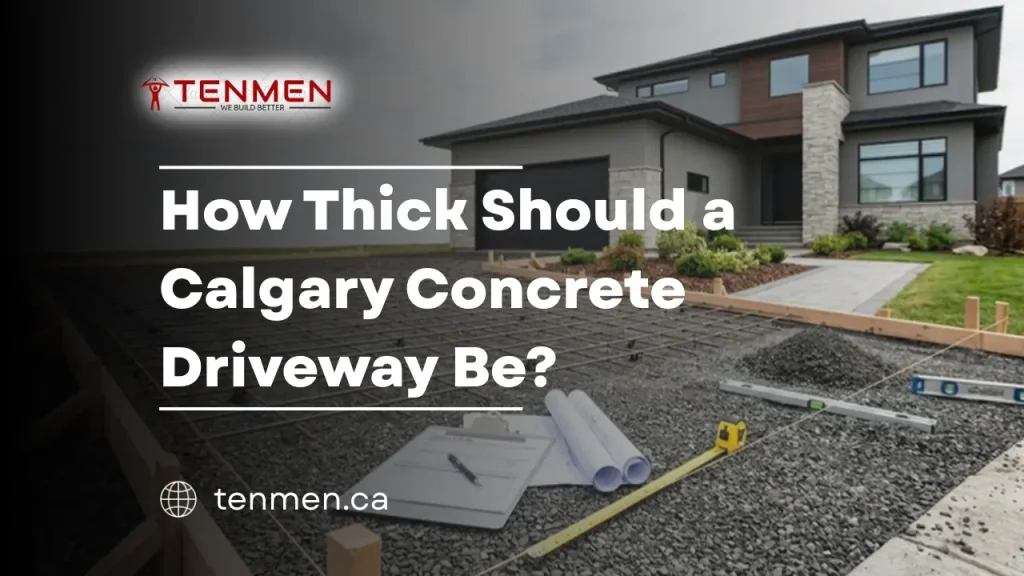
Homeowners comparing quotes for a new driveway often zero in on one number: the price per square foot. What they usually do not ask about is thickness, even though it is one of the biggest factors in whether that driveway is still crack-free in fifteen years or falling apart in five. Two quotes can look almost identical on paper while one contractor is planning to pour a noticeably thinner slab to save on material costs.
In Calgary and Airdrie, thickness matters more than it does in a lot of other cities because of what our driveways have to deal with. Between clay soil that expands and contracts with moisture, and freeze-thaw cycles that put constant stress on concrete throughout the winter, a driveway poured too thin or without proper support underneath will show it. Cracking, heaving, and premature wear are almost always traceable back to decisions made before the concrete truck ever showed up.
This article breaks down how thick a residential driveway should actually be, when you need to go thicker, and why thickness by itself is not a complete answer if the base underneath was not built correctly.
Standard Thickness for a Residential Driveway
For a typical residential driveway carrying passenger vehicles, a minimum concrete thickness of 4 inches is the standard most contractors work from in this region. That is enough to handle the day-to-day weight of cars and light trucks while giving the slab enough mass to resist cracking from normal freeze-thaw movement.
After pouring hundreds of driveways across Calgary and Airdrie, we can tell you that 4 inches is a reasonable baseline, but it is not automatically the right number for every driveway. The right thickness depends on what the driveway will actually be used for, not just what fits the budget.
When 4 Inches Is Not Enough
Several situations call for going thicker than the standard minimum:
- Driveways that regularly see heavier vehicles like trucks, trailers, or RVs
- Areas where a vehicle parks in the same spot repeatedly, concentrating the load
- Driveways that double as a parking pad for commercial vehicles or equipment
- Sections near the garage apron where turning and braking put extra stress on the slab
If any of these apply to you, it is worth discussing a thicker pour, typically in the 5 to 6 inch range, at least in the areas that will see the heaviest use. A good contractor will ask about how you actually use your driveway before finalizing a thickness rather than defaulting to the minimum across the board.
Why RV and Trailer Parking Changes the Equation
RVs and trailers are heavier and more concentrated in their weight distribution than a typical car, and a lot of homeowners underestimate how much extra stress that puts on a driveway. If you park an RV, boat trailer, or utility trailer on the same section of driveway regularly, that area needs to be built to handle sustained point loads, not just the passing weight of a vehicle driving over it.
On most Calgary jobsites where we know RV or trailer parking is part of the plan, we will recommend increasing thickness in that specific zone and paying closer attention to reinforcement and base compaction underneath it. Trying to save money by treating that section the same as the rest of a standard driveway is one of the most common mistakes homeowners make, and it usually shows up as sinking or cracking within a couple of years.
Reinforcement Matters as Much as Thickness
Thickness alone does not tell the whole story. A properly reinforced 4 inch slab can outperform a thicker slab with no reinforcement, because reinforcement is what helps the concrete resist the cracking forces created by soil movement and freeze-thaw cycling.
Reinforcement options include:
- Wire mesh, which offers basic crack control for standard driveways
- Rebar, which provides stronger reinforcement and is often recommended for driveways carrying heavier loads or built over less stable soil
- Fiber reinforcement, mixed directly into the concrete to help control surface cracking
Experienced concrete finishers know that reinforcement needs to sit in the correct position within the slab, generally in the upper to middle third, to actually do its job. Reinforcement that gets pushed to the bottom during the pour or laid directly on the base instead of properly supported provides far less benefit than it should.
The Base Underneath Matters More Than the Thickness Above It
This is the point most homeowners miss entirely: a thick, well-reinforced driveway poured over a poorly prepared base will still fail. The concrete on top can only perform as well as what is supporting it underneath.
Calgary sits on expansive clay soil that swells when saturated and shrinks as it dries out. If the base underneath a driveway is not excavated to proper depth and replaced with a compactable gravel base, that clay movement transfers directly into the concrete regardless of how thick the slab is. Proper site prep is something a lot of contractors skip past to save time, but it is genuinely the foundation of a long-lasting driveway.
What a Proper Base Looks Like
A base built for Calgary’s conditions typically includes:
- Excavation down to stable subgrade, removing organic material and unstable soil
- A compactable gravel base placed and compacted in layers rather than all at once
- Attention to drainage so water does not pool and saturate the base from below
- Consistent depth across the entire driveway, not just the areas that are easiest to access
When we assess a driveway project, the first thing we look at is not the concrete spec, it is what is happening below grade. A 4 inch slab over a properly compacted base will outperform a 6 inch slab poured over an inadequately prepared one almost every time.
How Slope and Drainage Affect Long-Term Performance
Thickness and reinforcement protect the slab structurally, but slope determines how much water sits on top of it. A driveway that does not shed water properly toward the street, away from the garage and foundation, will see accelerated wear regardless of how thick it is poured, because standing water that freezes and thaws repeatedly is one of the fastest ways to damage a concrete surface.
If you are planning a new driveway or comparing quotes, ask contractors how they plan to grade the slope, not just what thickness and mix they are proposing. Thickness protects against structural failure. Proper slope protects the surface itself from the kind of freeze-thaw damage covered in more detail in our guide on protecting your driveway from winter cracks and damage.
Air-Entrained Concrete and Why It Matters Here
Thickness and reinforcement address structural load, but the concrete mix itself needs to be built for freeze-thaw cycling specifically. Air-entrained concrete has microscopic air bubbles mixed into it that give water room to expand as it freezes, which reduces the internal pressure that causes surface scaling and cracking.
This is not optional in our climate. A driveway poured with a mix that is not air-entrained, no matter how thick, is more vulnerable to the kind of surface damage that shows up after just a few Alberta winters. If you want to understand how these factors combine to affect a driveway’s overall lifespan, our article on how long concrete lasts in Calgary covers this in more depth.
Getting the Right Thickness for Your Driveway
There is no single correct thickness that applies to every property. The right answer depends on:
- What kind of vehicles regularly use the driveway
- Whether RV, trailer, or equipment parking is part of the plan
- The condition and type of soil on your specific property
- Whether the driveway ties into a garage pad or other concrete work
A contractor who quotes a thickness without asking about any of this is guessing. A contractor who asks how you use the space, inspects the site, and explains their reasoning is giving you a number based on your actual situation, not a generic default. If your project also includes a concrete garage pad or connecting sidewalk, those areas should be planned together so thickness and base depth are consistent across the whole job.
Get a Thickness and Base Recommendation Built for Your Property
If you are planning a new driveway, or replacing one that is already showing cracks and settling, getting the thickness and base right from the start is what determines whether you are dealing with this project again in five years or not for decades. Tenmen Construction builds every driveway for Alberta’s freeze-thaw climate, with proper base prep, appropriate reinforcement, and air-entrained mixes suited to the load your driveway will actually carry.
We serve Calgary, Airdrie, Chestermere, Cochrane, and Okotoks, and we offer free on-site estimates with transparent, line-item pricing so you know exactly what thickness and base work is included before we start. Explore our full concrete driveways page to see examples of past work, or check our guide to driveway costs in Calgary if you are still budgeting.
Call us at (825) 882-9406 for your free estimate, or reach out through our contact page to get started.