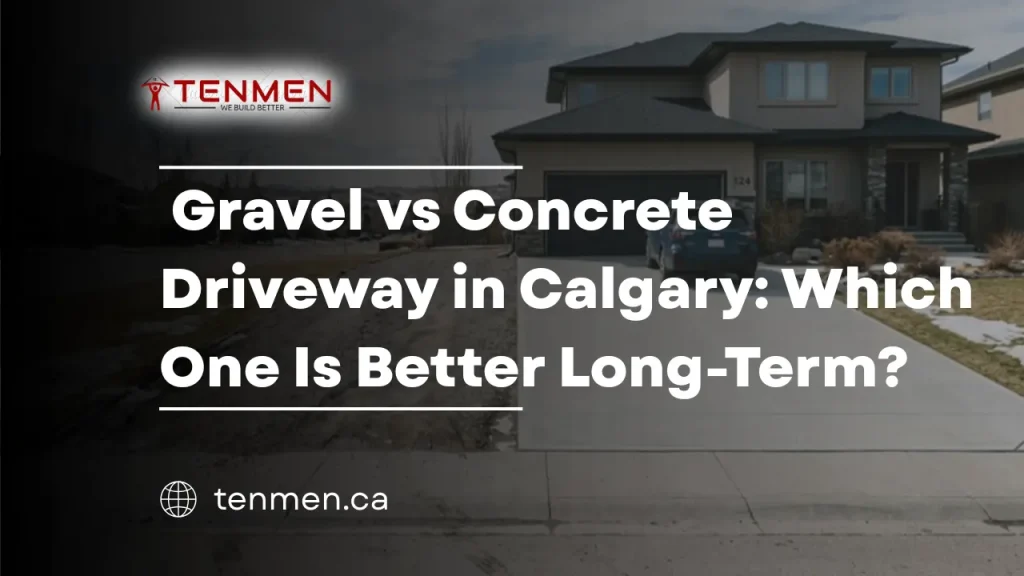
If you’ve lived with a gravel driveway through a Calgary winter, you already know the drill. You’re out there in April with a rake, trying to figure out where all the gravel went after the snowplow came through, or you’re tracking mud into the house every time it rains in June. It works, technically. But “works” and “works well” are two different things once you start adding up the time, mess, and repeated cost of keeping gravel looking decent year after year.
This is one of the most common questions we hear from homeowners in Calgary and Airdrie, especially those who bought a place with an unfinished or gravel parking pad and are trying to decide if it’s worth upgrading. There’s no universal right answer, but there is a clear pattern once you look at snow removal, maintenance, appearance, and what each surface does to your property value over time.
Here’s how gravel and concrete actually compare when you account for Alberta’s freeze-thaw cycles, clay soil, and the way chinooks can swing temperatures 20 to 30 degrees in a single afternoon.
Snow Removal: Gravel Fights You, Concrete Doesn’t
Snow removal is where the difference between gravel and concrete driveways shows up fastest, usually within the first winter.
With gravel, every pass of a snowblower or plow risks pulling stone up with the snow. You end up either being overly cautious (and leaving ice packed down that turns dangerous) or aggressive (and losing a truckload of gravel into your yard or the street). Either way, you’re topping up gravel almost every spring, which is an ongoing cost most homeowners don’t factor in when they first go the gravel route.
A concrete driveway gives you a hard, flat, predictable surface. Snowblowers and shovels glide across it without catching on loose material. Ice melt products work more effectively on concrete because they’re not filtering down through gaps in stone. On most Calgary jobsites, we see clients who upgraded from gravel to concrete specifically because they were tired of the driveway becoming a January hazard.
Mud, Dust, and the Mess Factor
Gravel driveways have a seasonal personality problem. In spring, when the frost comes out of Calgary’s clay soil, gravel driveways can turn soft and muddy, sometimes for weeks. In dry, windy stretches (which Calgary gets plenty of), the same driveway kicks up dust that settles on vehicles, siding, and anything left outside.
Concrete doesn’t have this problem. It sheds water instead of absorbing it, and there’s no loose surface material to turn into dust or mud. If you’ve got kids, pets, or you’re simply tired of vacuuming out your vehicle every week, this alone is often enough to tip the decision toward concrete.
Maintenance Over Time
This is where a lot of homeowners underestimate gravel. It looks low-maintenance on paper, but it actually needs regular attention to stay functional:
- Fresh gravel added every 1 to 3 years as material gets displaced by traffic, plowing, and erosion
- Regrading to smooth out ruts and low spots where water pools
- Weed control, since gravel is an easy place for weeds to root
- Constant redistribution after heavy rain or snowmelt washes gravel toward the low side of the driveway
Concrete maintenance is a different category entirely. A properly installed driveway, poured with the right base prep and air-entrained mix for our climate, mainly needs occasional sealing and crack monitoring. We always recommend sealing every couple of years to protect against the freeze-thaw cycles that are hard on any concrete surface in this region. Compared to the recurring cost and labour of maintaining gravel, it’s a much smaller ongoing commitment. Our driveway crack protection guide goes into more detail on what that seasonal upkeep should look like.
Appearance and Curb Appeal
Gravel can look fine on a rural property or a long rural laneway, but on a residential lot in Calgary or Airdrie, it tends to read as unfinished, even when it’s well kept. Buyers and appraisers notice the difference between a gravel pad and a properly poured driveway.
Concrete gives you a clean, finished look right out of the gate, and it opens the door to upgrades that gravel simply can’t offer. Homeowners who want a bit more visual interest often go with exposed aggregate for texture and grip, or stamped concrete if they want a pattern that mimics stone or brick without the stone or brick price tag. Even a standard broom finish looks significantly more polished than gravel, and it’s still budget-friendly.
Long-Term Durability in Calgary’s Climate
This is the part that really separates the two materials. Gravel doesn’t fail in the traditional sense, but it also never stabilizes. It’s in a constant state of shifting, settling, and needing to be replenished, which means the “cost” of gravel doesn’t stop after installation. It just spreads out over the years in smaller, recurring expenses.
A properly built concrete driveway is designed to handle exactly what Calgary throws at it. Proper base prep, rebar reinforcement, and air-entrained concrete are what keep a driveway from heaving and cracking as the ground freezes and thaws through our winters. Experienced concrete finishers know that skipping proper base compaction is one of the most common reasons driveways fail early, and it’s something we’re careful never to shortcut. Done right, a concrete driveway in this climate can last decades with only routine sealing and minor crack repair, and you can see real numbers on that in our article on how long concrete lasts in Calgary.
Property Value: Where the Investment Pays Off
Gravel driveways are typically viewed as a placeholder, not a finished feature. When it comes time to sell, a gravel pad can actually work against your home’s perceived value, especially in neighborhoods where most driveways are paved or poured.
Concrete driveways are one of the more straightforward upgrades that adds real, recognizable value to a property. It signals that the exterior of the home has been properly finished and maintained, which matters a lot to buyers doing a quick visual assessment during a showing. If you’re planning to sell within the next few years, replacing gravel with concrete is one of the more cost-effective ways to boost curb appeal and first impressions.
When It Makes Sense to Upgrade from Gravel to Concrete
Not every gravel driveway needs to be replaced immediately, but there are a few signs it’s time to consider the switch:
You’re Tired of the Seasonal Cycle
If you find yourself dealing with mud in spring, dust in summer, and gravel loss every winter, that seasonal cycle isn’t going away on its own. It’s a pattern that repeats every single year until the surface changes.
You’re Preparing to Sell
If a sale is on the horizon, upgrading a gravel pad to a finished concrete driveway is one of the better return-on-investment exterior projects available, especially compared to larger renovations.
The Gravel Base Has Never Been Properly Compacted
A lot of gravel driveways in Calgary and Airdrie were never built with proper base compaction in the first place. If yours has always felt soft, uneven, or prone to potholes, pouring concrete over a properly prepped base solves a problem that regrading gravel never actually fixes.
You Want a Driveway That Matches the Rest of the Home
If the rest of your exterior has been updated (landscaping, siding, walkways) but the driveway is still gravel, it tends to stand out for the wrong reasons. Concrete is usually the missing piece that ties the whole exterior together.
Get a Straight Answer From a Calgary Concrete Crew
Deciding between gravel and concrete comes down to how much ongoing maintenance you’re willing to take on versus how much you want a finished, durable surface that holds up in Alberta’s climate. For most homeowners in Calgary and Airdrie, once the recurring cost and hassle of gravel gets added up, concrete ends up being the better long-term investment.
If you’re weighing a gravel-to-concrete upgrade, our concrete driveway services page breaks down the process from base prep to finishing, and our guide on concrete driveway costs in Calgary can help you budget before you commit to anything.
Tenmen Construction offers free on-site estimates with transparent, line-item pricing, so you know exactly what you’re paying for before work starts. Give us a call at (825) 882-9406 and we’ll walk your property, talk through your options, and give you a straight answer on what it’ll take to replace that gravel pad for good.